


CBAM: Beyond the horizon, things continue sustainably
The Carbon Border Adjustment Mechanism (CBAM), also known as the CO₂ border adjustment mechanism, is an EU instrument that aims to put a price on CO₂ emissions from imported products and thus prevent carbon leakage. Carbon leakage describes the risk that emissions from production are shifted to countries with lower climate targets in order to avoid reduction targets.
CBAM is intended to align imports from countries with lower climate standards with the EU's CO₂ price. This creates fairer competitive conditions and provides incentives for lower-emission production worldwide.
The CBAM Regulation requires precise calculation and documentation of CO₂ emissions along the supply chain in the form of a CBAM reporting obligation for importers and is based on international standards such as the GHG Protocol to measure emissions in Scope 1 (direct emissions) and Scope 2 (indirect emissions through energy consumption).

Who is affected by the CBAM Regulation?
The CBAM Regulation primarily affects energy-intensive industries and companies that export to the European market or import products from third countries. As part of the CSRD and other regulations, companies are subject to new obligations to calculate and consistently document their emissions.
Actors affected are in particular
- Producers and importers of steel, cement, fertilizers, aluminium and electricity, who must now ensure that their supply chains have a complete carbon footprint.
- Industrial companies that want to secure their competitiveness in the European market by adapting to the new regulations.
- Investors and stakeholders who demand more transparency about companies' sustainability efforts and monitor compliance with the new CO₂ standards.
CBAM is not only an important step towards implementing the European climate targets, but also supports a fair competitive landscape for companies with high environmental standards.
How CBAM software like Substain helps with CBAM reporting


Substain's most important functions for CBAM calculation and reporting
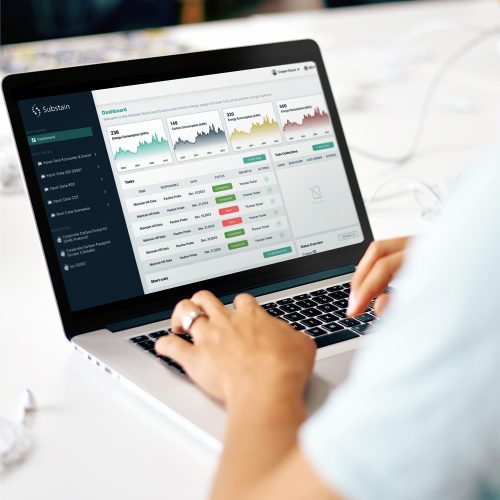
Substain offers an intuitive and efficient solution to meet CBAM requirements and accurately manage CO₂ emissions along the supply chain:
- Data collection and emissions calculation:
Substain helps companies to collect relevant emissions data in a structured way, especially for Scopes 1 and 2. The software provides default settings based on the guidelines of the GHG Protocol to ensure reliable collection and calculation of emissions data. - Automated calculation and reporting:
The software calculates emissions based on the data collected and generates CBAM-compliant reports. These reports are ideal for internal analysis and for submission to relevant authorities or for communication to stakeholders. - Regular updating and compliance monitoring:
Substain allows continuous monitoring and updating of emissions data along the supply chains, so that companies can ensure their compliance with CBAM on an ongoing basis. In this way, companies can adapt flexibly to new regulatory requirements and ensure compliance with all specifications.

Get to know other software modules


