
Current web seminars from our sister company ConClimate:
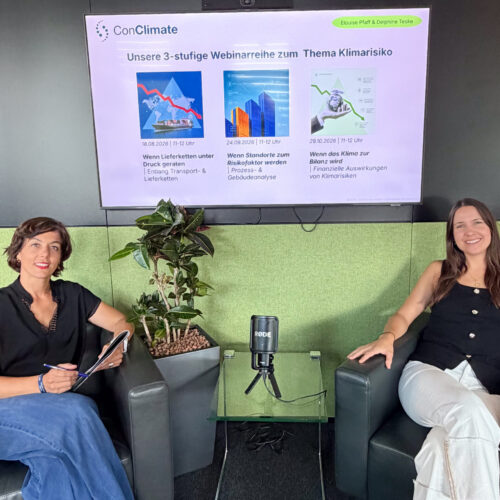
Part 1: Climate Risks in Supply Chains and Logistics—Identifying Vulnerabilities, Avoiding Disruptions
August 18, 2026, 11:00 a.m. (60 min.)
Part 1 of the webinar series: Understanding, Assessing, and Managing Climate Risks—for Resilient Supply Chains, Processes, and Corporate Finances.
When a port comes to a standstill, a river runs low, or a key supplier is affected by extreme weather, the impact is often felt far beyond the actual location of the event. Climate risks do not stop at corporate boundaries—they extend throughout the entire value chain.
This webinar examines the greatest climate risks along global supply chains and transportation routes. Together, we’ll take a look at critical dependencies, typical risk hotspots, and how companies can build greater transparency and resilience into their supply chains.
Sustainability Reporting 2026: Your Guide to the New Rules
September 17, 2026, 11:00 a.m. (60 min.)
The rules for sustainability reporting are changing—and in a fundamental way. With the European Commission’s adoption of the revised ESRS and the new Voluntary Standard on July 3, 2026, many companies are asking themselves the same questions: What does this mean for us now? What, specifically, is changing? And when do the changes take effect?
In this webinar, we’ll break down the latest developments for you—in a concise, easy-to-understand way with clear practical applications. You’ll learn:
-
What has changed with the CSRD?
-
what lies behind the revised ESRS (ESRS 2.0) and the new Voluntary Standard,
- which obligations, deadlines, and exemptions apply to which companies,
- and what steps make sense to take now to be prepared.
For everyone who wants to stay on top of things—and make the right decisions.

Part 2. Climate Risk Analysis for Buildings and Processes – Resilience Starts Within Your Own Organization
September 24, 2026, 11:00 a.m. (60 min.)
Heat, heavy rain, or flooding often hit businesses where it hurts the most: in buildings, facilities, and critical business processes. The real challenge lies in identifying which areas are truly affected and where action is needed.
Using the OCARA method (Operational Climate Adaptation and Resilience Assessment), we demonstrate how operational risks can be systematically assessed and prioritized. The central question is: How resilient is your company today—and how resilient does it need to be tomorrow?
Part 3: The Financial Impact of Climate Risks on Your Business
October 29, 2026, 11:00 a.m. (60 min.)
What do climate risks actually mean for a company’s costs, investments, and economic future? Between production losses, rising insurance costs, and regulatory changes, risks are emerging that are increasingly reflected in key business metrics.
This webinar combines climate risk analysis with a financial perspective. It focuses on how climate risks translate into measurable impacts on earnings, enterprise value, and the balance sheet—and how companies can account for these effects early on.
Past web seminars:
Combine EcoVadis & VS(ME) – Instead of Doing the Same Work Twice
August 13, 2026, 11:00 a.m. (60 min.)
Many companies are currently caught between two worlds:
First, many companies use theVS(ME) asa recognized reporting framework. Second, the goal is to optimize theEcoVadis score.
Both require ESG data and targets, but their requirements only partially overlap. The result? Often, this leads to duplicate work and documents in a wide variety of formats.
This is exactly where a new solution comes in:
A module that connects VS(ME) as a streamlined framework with the EcoVadis assessment logic, systematically bringing both worlds together for the first time.
Here's what you'll learn in the webinar:
- Which content from VS(ME) and EcoVadis overlaps—and only needs to be prepared once
- How the software module becomes a driver of efficiency
- How Substain’s VSME+EcoVadis module and ConClimate’s consulting services work together
Register for the webinar now and learn how to effectively integrate VS(ME) and EcoVadis.

Carbon Accounting in Practice: Implementing CCF and PCF Efficiently with Substain
July 15, 2026, 11:00 a.m. (60 min)
The focus is on two key areas of application:
Systematically track and analyze emissions at the corporate level.
Calculate and document product-specific carbon footprints.
For sustainability, ESG, and carbon accounting teams, as well as companies that want to efficiently map their CCF or PCF processes using Substain.

EmpCo in Practice: How to Formulate Sustainability Statements Correctly
July 8, 2026, 11:00 a.m. (60 min)
Many sustainability and climate claims sound convincing at first glance—but under the new requirements of the EmpCo Directive, they can quickly be deemed too vague, too general, or insufficiently substantiated. Terms such as “sustainable,” “climate-neutral,” “environmentally friendly,” or “low-carbon” are increasingly coming under scrutiny when it is unclear what the statement specifically refers to and how it can be substantiated.
But how can a vague environmental statement be transformed into a clear, robust, and EmpCo-compliant statement?
In this webinar, we’ll take a hands-on approach to working with typical phrasing found in corporate communications, product descriptions, websites, social media, and sales materials. Using 10 to 15 specific, real-world examples of claims, we’ll demonstrate step by step why certain statements are problematic—and how they can be reworded to be precise, credible, and compliant with corporate communication guidelines.
The session is deliberately designed as a workshop on rephrasing: minimal theory, plenty of examples, and practical guidelines for crafting language. This provides SMEs in particular with tangible guidance and concrete templates they can use for their own sustainability and climate-related texts.
What you can expect:
- Why many common sustainability claims become problematic under EmpCo
- How general statements are transformed into precise and verifiable statements
- 10 to 15 before-and-after examples from typical communication channels
- What information is needed for a sound environmental statement: context, evidence, data sources, and limitations
- How Companies Can Reduce Greenwashing Risks Without Sacrificing Effective Communication
Understanding product carbon footprints correctly – fundamentals for reliable product CO₂ balances
July 2, 2026, 10:00 a.m. (60 min)
The Product Carbon Footprint (PCF) is rapidly gaining importance. Customers, business partners, and regulators are increasingly demanding transparent CO₂e emissions at the product level.
However, a PCF is only reliable if the methodology and data are correct.
In this webinar, you will learn:
- What a product carbon footprint is—and how it differs from a corporate carbon footprint (CCF)
- Why functional units and system boundaries determine comparability
- How high data quality really needs to be—and where pragmatic solutions make sense
- What strategic advantages does a clean product carbon footprint offer?
You will receive a clear, practical classification – so that your PCF is more than just a CO₂ figure.


Climate Risks Along Supply Chains and Logistics – Identifying, Assessing, and Managing Risks
June 11, 2026, 10:00 a.m. (60 min)
Supply chains are increasingly exposed to the effects of climate change: extreme weather events, changing transportation conditions, and regional risks can significantly impact the availability of raw materials and the stability of supply relationships. At the same time, companies are facing growing demands to systematically analyze and manage these risks.
In this webinar, you will learn how to systematically identify and assess climate risks along your supply chains and transportation routes.We will show you how to develop a sensitivity portfolio for your supply chain based on supplier assessments, and explain the role that location-based data and GIS analyses play in this process. In addition, we’ll provide practical insights into best practices, common challenges, and concrete approaches to prioritizing risks and mitigation measures.
Take this opportunity to gain insight into your supply chain risks and strengthen your company’s resilience in a targeted manner.

Combine EcoVadis and VSME – instead of doing the same work twice
June 9, 2026, 11:00 a.m. (60 min)
Many companies are currently caught between two worlds:
First, many companies use theVSME asa recognized reporting framework. Second, the goal is to improve theEcoVadis score.
Both require ESG data and targets, but their requirements only partially overlap. The result? Often, this leads to duplicate work and documents in a wide variety of formats.
This is exactly where a new solution comes in:
A module that connects VSME as a streamlined framework with the EcoVadis assessment logic, systematically bringing both worlds together for the first time.
Here's what you'll learn in the webinar:
- Which content from VSME and EcoVadis overlaps—and only needs to be prepared once
- How the software module becomes a driver of efficiency
- How Substain’s VSME+EcoVadis module and ConClimate’s consulting services work together
Register for the webinar now and learn how VSME and EcoVadis can be effectively integrated.
Understanding product carbon footprints correctly – fundamentals for reliable product CO₂ balances
March 19, 2026, 11 a.m. (60 min)
The Product Carbon Footprint (PCF) is rapidly gaining importance. Customers, business partners, and regulators are increasingly demanding transparent CO₂e emissions at the product level.
However, a PCF is only reliable if the methodology and data are correct.
In this webinar, you will learn:
- What a product carbon footprint is—and how it differs from a corporate carbon footprint (CCF)
- Why functional units and system boundaries determine comparability
- How high data quality really needs to be—and where pragmatic solutions make sense
- What strategic advantages does a clean product carbon footprint offer?
You will receive a clear, practical classification – so that your PCF is more than just a CO₂ figure.
From CO₂ data to reliable climate communication – what EmpCo now demands
March 18, 2026, 10 a.m. (60 min)
The EmpCo Directive significantly increases the requirements for climate statements. Terms such as "climate neutral" or "CO₂-compensated" are increasingly subject to regulatory scrutiny. In the future, companies must be able to clearly demonstrate the basis for their statements—methodologically, strategically, and organizationally.
But what does that mean in practice?
In this webinar, we will show you the technical fundamentals required to make climate communication robust and legally compliant: from a consistent carbon footprint and well-founded reduction targets to effective climate management. We will also classify the role that climate protection projects and offsetting actually play in the context of stricter requirements.
What you can expect:
- What requirements EmpCo places on climate statements
- Why CO₂ data and reduction targets are essential for credible communication
- How climate management should be systematically structured
- How climate protection projects and offsetting should be classified in regulatory terms
Managing change instead of administering it – how change management really works
February 26, 2026, 10 a.m. (45 min)
Structured planning, effective employee involvement, and measurable success.

Rethinking sustainability: ESG as the key to resilience and growth
February 3, 2026, 10 a.m. (60 min)
- The webinar "Rethinking Sustainability: ESG as the Key to Resilience and Growth" shows how companies can use ESG not only as a compliance issue, but also asa strategic success factor. Even with the current regulatory easing, ESG remains crucial for minimizing risks, increasing resilience, and securing long-term competitive advantages.It explains how ESG can be used as a risk management tool for banks and investors and as a basis for transformation in companies.Participants will learn how asystematic ESG strategycan help them meet stakeholder requirements, manage climate risks, and effectively improve their sustainability performance.The focus is on pragmatic implementation and the use of digital tools for successful ESG integration.Q&A
Understanding EcoVadis - your path to a strong sustainability rating
Thu. 05.02.2026, 10 a.m. (60 min)

Substain for your ESG practice: Overview of application areas
January 28, 2026, 10 a.m. (60 min)
How Substain supports companies in three key ESG application areas
Sustainability management is becoming mandatory—and a strategic task. In this webinar, we will show you how companies are using Substain in practice to master complex ESG challenges efficiently and in a future-proof manner.
The focus is on the platform's three typical areas of application:
- Life cycle & carbon management
- ESG Management
- Regulatory & Reporting
Who is this webinar suitable for?
- Sustainability officers, ESG and compliance teams
- Companies that want to organize ESG reporting efficiently
- Organizations with growing reporting needs or new regulatory obligations
Get a practical overview of the platform's features and learn how Substain flexibly adapts to your requirements—not the other way around.
take with you.
ESG start without CSRD obligation: Practical experience with SNOCKS
January 23, 2026, 11 a.m. (45 min)
Many companies are currently faced with the question of how they can approach ESG in a meaningful way—even without CSRD requirements, a large team, or extensive prior experience.
In this45-minute webinar,SNOCKSandConClimateprovide insights into their joint practice:
How was the ESG launch structured? Which steps have proven successful? And what is particularly important when resources are limited?
Lisa, Sustainability and Compliance Group Lead at SNOCKS Group, reports firsthand on the ESG launch at SNOCKS—from the classification of relevant topics and thedouble materiality analysisto key decision-making processes in setting up an ESG structure.
The webinar is aimed at companies that want to implement ESGpragmatically, realistically, and step by step—and are looking for sound guidance on how to get started.
What you can expect:
- Practical insights into getting started with ESG at SNOCKS
- Classification of the double materiality analysis as a starting point
- Lessons learned from collaboration between companies and consultants
- Space for questions and discussion in the Q&A

Recognizing climate risks and strengthening resilience: The roadmap to future-proof your business
Thu. 22.01.2026, 11 a.m. (60 min)
Find out in our webinar how you can manage ESG key figures efficiently and transparently with the Substain digital platform.
Climate change brings new challenges for companies: Supply chains are disrupted, legal requirements and market changes require strategic action. In the webinar, we will show you how to systematically identify and assess climate risks and derive targeted measures with the help of a resilience analysis.
Our experts present tried-and-tested methods for strengthening your company's resilience and securing long-term competitive advantages.
Register now and make your company future-proof!

Effective climate contribution presented transparently
Thu. 11.12.2025, 11 a.m. (60 min)
Those who really take climate protection seriously pursue a holistic approach:
An effective contribution begins with a well-founded carbon footprint, followed by a consistent reduction in emissions - and only then does it rely on targeted investments in high-quality, certified climate protection projects.
It is just as important to communicate this climate contribution in a transparent and comprehensible way.
Companies can use our new landing page to present their climate protection projects and sustainability activities in a structured way, view certificates and project data and make their progress verifiable at any time - whether via QR code, website link or in the sustainability report.
In this webinar you will learn:
- How companies can make their climate contribution strategically effective and compliant
- How regional and international projects can be sensibly combined
- How to create maximum transparency through online verification, project data and certificates
- How to present your climate contribution professionally on the new landing page and build trust with stakeholders
Get a clear, practical overview of how climate contributions and sustainability activities can be implemented and presented visibly, credibly and effectively in the long term.


Manage ESG key figures digitally with Substain
Do. 15.01.2026, 10 a.m. (60 min)
Find out in our webinar how you can manage ESG key figures efficiently and transparently with the Substain digital platform.
Learn how to collect, analyze and report on data to make your sustainability goals measurable. Discover practical functions that will take your ESG management to the next level.
Climate contribution with impact
Wed. 09.10.2025, 10 am (45 min)
Offsetting CO₂ often sounds like a quick indulgence.
Anyone who really takes climate protection seriously takes a holistic approach:
An effective contribution begins with a well-founded CO₂ balance sheet,
follows a consistent reduction in emissions
- and only then focuses on targeted investments in high-quality, certified climate protection projects.
In this webinar you will learn:
- How companies strategically and effectively shape their climate contribution
- How regional and international projects can be sensibly combined
- How to create maximum transparency through online verification, project information and certificates
Get a clear and practical overview,
how climate contributions can be implemented visibly, credibly and effectively in the long term.

Recognizing climate risks and strengthening resilience: The roadmap to future-proof your business
Wed 18.09.2025, 10 am (45 min)
Find out in our webinar how you can manage ESG key figures efficiently and transparently with the Substain digital platform.
Climate change brings new challenges for companies: Supply chains are disrupted, legal requirements and market changes require strategic action. In the webinar, we will show you how to systematically identify and assess climate risks and derive targeted measures with the help of a resilience analysis.
Our experts present tried-and-tested methods for strengthening your company's resilience and securing long-term competitive advantages.
Register now and make your company future-proof!
Implementing EUDR - navigating the jungle of requirements with Substain
Wed. 28.08.2025, 10 am (60 min)
The new EU regulation on deforestation-free supply chains (EUDR) comes into force on December 30, 2025 - and imposes new due diligence obligations on companies that use raw materials such as wood, soy, palm oil, cocoa, beef, coffee or rubber.
How can you prepare efficiently and implement the requirements of the EUDR easily and in compliance with the law?
In our practice-oriented EUDR webinar you will receive:
-
A compact overview of the central contents and obligations of the regulation,
-
Concrete tips on what your company needs to pay attention to based on a practical example - from traceability to due diligence,
-
An exclusive insight into our EUDR software module, which provides you with automated support for data collection, supplier queries and risk analysis.
Start well prepared for the EUDR obligation with Substain - we show you how.

Buon Appetito: A look at L'Osteria's sustainability recipe with insights into ESG, ESRS and practical implementation
Thu 26.06.2025, 10 am (50 min)
L'Osteria is actively driving sustainability forward - from ESG initiatives to the implementation of the new ESRS reporting requirements. Together with Fabienne Schulte, Senior Sustainability Manager at L'Osteria, we talk about how the company is developing its ESG strategy, what the ESRS preparation meant and how internal communication on the complex reporting system is being organized.
This shows how L'Osteria thinks about ESG strategy and reporting together - and is taking this path with ConClimate.

Understanding and implementing EUDR - clearly navigating the jungle of requirements with Substain
Wed 26.06.2025, 10 am (60 min)
The new EU regulation on deforestation-free supply chains (EUDR) comes into force on December 30, 2025 - and imposes new due diligence obligations on companies that use raw materials such as wood, soy, palm oil, cocoa, beef, coffee or rubber.
How can you prepare efficiently and implement the requirements of the EUDR easily and in compliance with the law?
In our practice-oriented EUDR webinar you will receive:
- A compact overview of the central contents and obligations of the regulation,
- Concrete tips on what your company needs to pay attention to based on a practical example from the publishing industry - from traceability to due diligence,
- An exclusive insight into our EUDR software module, which provides you with automated support for data collection, supplier queries and risk analysis.
Start well prepared for the EUDR obligation with Substain - we show you how.
Recognizing climate risks and strengthening resilience: The roadmap to future-proof your business
Wed 04.06.2025, 10 am (45 min)
Find out in our webinar how you can manage ESG key figures efficiently and transparently with the Substain digital platform.
Climate change brings new challenges for companies: Supply chains are disrupted, legal requirements and market changes require strategic action. In the webinar, we will show you how to systematically identify and assess climate risks and derive targeted measures with the help of a resilience analysis.
Our experts present tried-and-tested methods for strengthening your company's resilience and securing long-term competitive advantages.
Register now and make your company future-proof!

Understanding the correct scope of the ESRS report: Here's how!
In the webinar, we answer the most pressing questions and give you an overview of the requirements of the E1 standard. Our experts will explain what content is required for the ESRS report and how you can best manage it.
Manage ESG key figures digitally with Substain
Find out in our webinar how you can manage ESG key figures efficiently and transparently with the Substain digital platform.
Learn how to collect, analyze and report on data to make your sustainability goals measurable. Discover practical functions that will take your ESG management to the next level.
Understanding the correct scope of the ESRS report: Here's how!
Do you still have questions about the ESRS report?
In the webinar, we answer the most pressing questions, give you an overview of the requirements of the standards and what they mean in practice. Our experts will explain what content is required for the ESRS report and how you can best manage it.
This webinar is being held in cooperation with climate protection companies.

Software-supported ESG management
How can I shape the sustainable transformation of my company in a future-proof and holistic way?
Sustainability now plays a central role in companies. Whether CO2-accounting, the CSRD obligation, the ESRS standard or energy and environmental reports - the requirements for sustainability management are becoming more complex from year to year. However, many companies find it difficult to record or process the relevant data in a standardized, dynamic and intelligent way.
If you feel the same way and your company is interested in an innovative solution for digital data preparation and evaluation in the field of ESG, register for our web seminar in which we will give you an insight into our cloud-based software Substain.
Topics are:
- Presentation of ConClimate and services
- Introduction of Substain


Detailed insights into the double materiality analysis according to CSRD
Learn more about the detailed approach of the double materiality analysis in accordance with the Corporate Sustainability Reporting Directive (CSRD) and find out how you can carry out this analysis effectively for your company. Our webinar offers comprehensive insights into the methodological approach, stakeholder involvement, the project process and the expected results.
CSRD-Ready: efficiently mastering the EU reporting obligation
Discover in our webinar "CSRD-Ready: Mastering EU reporting requirements efficiently" how you can prepare your company for the new EU reporting requirements in a pragmatic and resource-saving way - without unnecessary bureaucracy and disproportionate effort. Find out how you can use the CSRD as a strategic success factor and apply inspiring practical examples from the corporate world.
Our focus topics:
- Introduction to the CSRD: Understand the new EU reporting requirements and what they mean for your company.
- Success factors for efficient implementation: Discover the most important strategies and approaches for meeting CSRD requirements in a targeted and resource-efficient manner.
- CSRD as an opportunity and success factor: Find out how CSRD can strategically strengthen your company and create competitive advantages.
- Inspiring practical examples: Be inspired by companies that are already successfully "CSRD-ready".

ESRS in practice: Your introduction to dual materiality analysis
How do you get started with CSRD reporting?
Since the introduction of mandatory reporting, the implementation of CSRD requirements has played a central role in many companies. This has made the requirements for modern sustainability management significantly more complex.
Many companies are wondering how they can get started with CSRD reporting.
We look forward to your participation in this webinar to show you how we can find sustainable solutions together and what role ConClimate plays in this.
Topics are:
- General presentation of ConClimate and its services
- Presentation of the ConClimate method:
- Creation of a cross-departmental basis - e.g. building up know-how within the company
- The path to a double materiality analysis
Software-supported ESG management
How can I shape the sustainable transformation of my company in a future-proof and holistic way?
Sustainability now plays a central role in companies. Whether CO2-accounting, the CSRD obligation, the ESRS standard or energy and environmental reports - the requirements for sustainability management are becoming more complex from year to year. However, many companies find it difficult to record or process the relevant data in a standardized, dynamic and intelligent way.
If you feel the same way and your company is interested in an innovative solution for digital data preparation and evaluation in the field of ESG, register for our web seminar in which we will give you an insight into our cloud-based software Substain.
Topics are:
- Presentation of ConClimate and services
- Introduction of Substain


ESRS - the future of reporting under the CSRD
For many companies, 2024 is the year of the dress rehearsal for sustainable reporting in accordance with ESRS (short for European Sustainability Reporting Standards). While the EU CSRD sets out the requirements and obligations for reporting, the ESRS reporting standard provides a framework and methodology. The ESRS not only requires strategic efforts and the assessment of risks and opportunities, but also aims to make sustainability visible by means of predefined KPIs. In our webinar, we will show you how your company can prepare for the new reporting standard, which KPIs are important and what a possible roadmap could look like.
How companies with science-based targets are heading towards Net-Zero
Set sound climate targets & monitor digitally
How does your company manage to act in line with the 1.5 degree target of the Paris Climate Agreement? More than 15,000 companies in Germany will soon have to answer this question - as required by the new European reporting obligation, also known as the Corporate Sustainability Reporting Directive (CSRD for short).
Implementing corporate climate protection means setting CO₂ reduction targets in line with scientific findings after taking stock and aligning the company with these targets using effective measures.
Topics are:
- What are science-based targets?
- How are goals implemented?
- How can climate targets and corporate reality be reconciled?
- How can progress be quantified and shown in reports?


Green HRM
How does modern HR development strengthen a sustainable corporate culture?
Over 76% of employees think it is important for employers to place a high value on sustainability (Stepstone). Whether for applicants, employees or consumers - the following applies: those who fulfill sustainability criteria are always more in demand.
The HR department has a key role to play in the transition to sustainable business practices: it must manage the change in the organization and bring HR and CSR together. Only then will climate targets find their way into the working environment of employees.
Although almost all HR managers are aware of the sustainability mandate, in practice sustainability is not yet widespread in human resource management (HRM)(HR managers, HRM Research Institutes). Only 36% pass on environmental knowledge to employees through training(HR managers, HRM Research Institutes). Green HRM closes this gap in practice.
Learn more about the opportunities of Green HRM on March 31 in our web seminar with Ms. Loock-Hummel, Head of Training and Development at SchwörerHaus KG:
Topics are:
- Introduction to Corporate Social Responsibility (CSR)
- Challenges and opportunities in HR management
- Characteristics of a sustainable employer brand
- HRM contribution to sustainability reporting
- Best practices of SchwörerHaus KG
Quantify and cost-effectively reduce CO₂ emissions
Host:
- Optenda GmbH: Expert for energy data management/www.optenda.de
- ConClimate GmbH: Management consultancy for climate protection & digital sustainability
Industry, trade and commerce are currently grappling with a major issue: How can we manage to reduce CO₂ emissions quickly and with few resources?
In our practical webinar, we will show you how to identify the emission drivers for your company using a CO₂ balance sheet and how to sustainably reduce consumption through cost-efficient energy data management.
Saving energy means lower CO₂ emissions and therefore lower costs!
Topics are:
- Relevance of climate protection for companies
- 4 steps for effective climate protection
- Use CO₂ balance sheet to identify emission drivers
- Reduce CO₂ emissions through energy data monitoring
- Digitalization of energy management


A sustainable, climate-neutral law firm offers advantages
Climate change is considered to be the greatest challenge of this century - and yet effective climate protection has so far only been given low priority in the self-image of many companies. The legal and tax consultancy sector is no exception. We will show you the advantages of climate neutrality for your law firm.
Topics are:
- Systematically record your law firm's CO₂ emissions (- from energy consumption to the vehicle fleet and business trips),
- identify initial reduction potential and develop the basis for effective climate management,
- use the "climate-neutral law firm" label effectively for your communication and
- digitize your sustainability management with the help of modern cloud software.
CO₂ balance, CO₂ reduction and climate neutrality for buildings
Topics are:
- The role of the building sector in climate change
- Holistic CO₂ balancing of buildings
- Short and long-term options for reducing CO₂ in buildings
- Climate neutrality for buildings

Climate change and climate protection - opportunities and risks for my company
Topics are:
- Climate, climate change, climate protection - what is it all about?
- German climate targets - the consequences for my company
- New target groups and new markets through active climate protection
- What can my company do in the short and long term
Effective climate protection management for corporates and SMEs (in english)
Topics are:
- Why climate change matters?
- International climate policy and regulations
- The urgency to adapt business models
- Measuring the carbon footprint
- Developing effective concepts for climate protection


Location-based climate protection management for companies and organizations
Topics are:
- Relevance of climate protection for companies
- Regulatory requirements
- Inventory and CO₂ balancing
- CO₂ reduction concept & climate neutrality
- Communication & monitoring