


Centralized data collection and structured analysis
The software flexibly maps your corporate structure, from individual locations to the parent company. This allows you to collect relevant data centrally, analyze Scope 1, 2, and 3 emissions in a targeted manner, and establish a robust foundation for reporting, climate goals, and actions.
- Centralized Collection of CO₂e Data
- Map Locations, Companies, and Responsibilities
- Conduct a Structured Analysis of Scope 1, 2, and 3
- Take Reports, Goals, and Actions a Step Further
Everything you need for your CCF, all in one platform
A corporate carbon footprint can quickly become confusing: data comes from various departments, locations, companies, and formats. Substain organizes this information into a clear structure so you can arrive at reliable results more quickly.


Carbon Footprint Software: Calculation with Substain
With Substain’s CCF module, companies can track and analyze their greenhouse gas emissions in a structured, transparent, and standards-compliant manner. The application covers Scope 1, 2, and relevant Scope 3 categories and is designed to be flexible enough to adapt seamlessly to individual corporate structures, from sole proprietorships to corporate holding companies.
Carbon footprint software for companies
Substain is the perfect solution for small and medium-sized businesses of all sizes and across a wide range of industries, from manufacturing and real estate to retail and services.
These customers are already using Substain:

With Substain and consulting from ConClimate, we have created a sustainable infrastructure for our sustainability management. The combination of CO₂ footprints at the company and product levels, along with structured ESG reporting, not only makes it easier for us to meet regulatory requirements but also provides crucial impetus for our strategic development.

With ConClimate and Substain, we have found the ideal combination of technical expertise and technological solution. The automated carbon footprinting and structured ESG data management create a reliable basis for us - both for stakeholder inquiries and for strategic decisions in the area of sustainability.

Using the PCF calculation tool, we can conduct detailed life-cycle assessments of individual construction site projects. In addition to meeting legal disclosure requirements (CSRD), this foundation enables us to develop targeted measures to reduce our environmental footprint.

"Thanks to this collaboration, we have developed an advancedCO2 calculation tool that enables us to transparently present theCO2 emissions of our products and implement targeted measures to reduce ourcarbon footprint."

The introduction of Substain has taken our sustainability processes to a new level. Automation and structuring not only improve efficiency but also provide us with reliable information that we can use for our sustainability strategy, stakeholder inquiries, and our ongoing innovation efforts.
How does your data get into Substain?
Upload
Upload data or documents using the provided upload templates and assign them to the appropriate categories.
API Interface
Integrate Substain with existing systems such as ERP, CRM, or order management, and automatically import data.
Manual entry
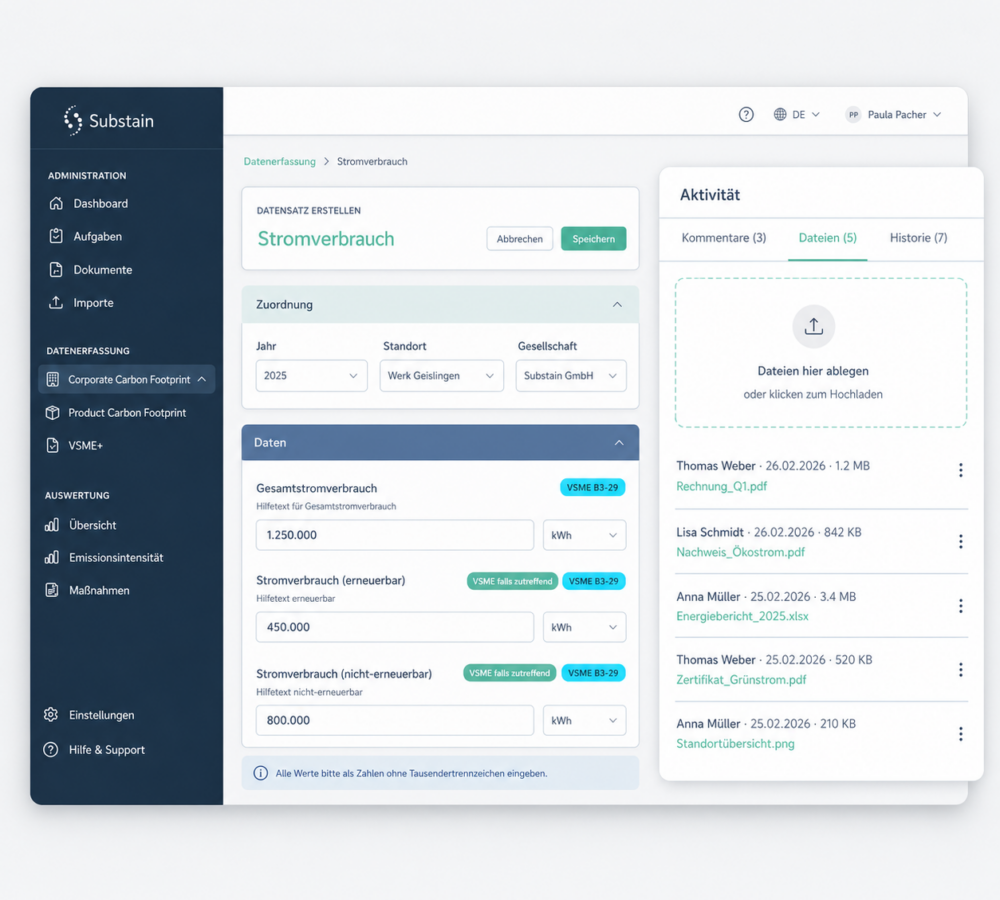
Enter data directly in your browser: guided, well-organized, and with clear input forms.
Here's how Substain adapts to your data environment: from the initial upload to the integrated interface.

Data is turned into analyses, reports, and decisions
With Substain, your corporate carbon footprint doesn't stop at data collection. The software makes emissions visible, comparable, and actionable—for management, reporting, and concrete reduction measures.
Interactive Reports
Identify emissions hotspots and compare results by scope, location, company, or category.
Scope 3 Detailed View
Identify which Scope 3 categories are particularly relevant and where the greatest opportunities for impact lie along the value chain.
PDF and Excel Export
Prepare results for internal reviews, ESG reports, or clients.
Goals and Measures
Set reduction targets, define actions, and track progress directly on the platform.
Software with technical support
Substain is more than just a tool. Behind the software is a team of ESG and carbon management experts who have been supporting companies with climate action, accounting, and reporting for over 6 years.
For you, this means that you’ll not only receive software that’s ready to use, but also expert support with setup, data structure, methodology, and application.

Carbon Footprint Software: Calculation with Substain
With Substain’s CCF module, companies can track and analyze their greenhouse gas emissions in a structured, transparent, and standards-compliant manner. The application covers Scope 1, 2, and relevant Scope 3 categories and is designed to be flexible enough to adapt seamlessly to individual corporate structures, from sole proprietorships to corporate holding companies.
What is a corporate carbon footprint?
A corporate carbon footprint shows a company's greenhouse gas emissions. It takes into account emissions from direct sources, purchased energy, and other upstream and downstream activities.
The CCF lays the groundwork for better understanding emissions, setting reduction targets, and tracking progress over time.

Which emissions are included in the CCF?
A corporate carbon footprint is typically calculated based on Scopes 1, 2, and 3.

FAQs Corporate Carbon Footprint
The term carbon footprint means CO₂ footprint. It describes the total amount of greenhouse gas emissions caused directly or indirectly by activities, products or companies. This includes energy consumption, transportation, production and supply chains. The CO₂ footprint is an important indicator for making climate impacts measurable and comparable.
Determining the carbon footprint enables companies to transparently record and better understand their ecological impact. Only those who know their emissions can develop effective strategies to reduce them and make progress measurable. Furthermore, the calculation is becoming increasingly important for sustainability reporting, particularly in the context of CSRD and ESRS requirements.
To determine the corporate carbon footprint, information from different areas of the company is brought together. This includes information on energy and resource consumption, business travel and commuting behavior, waste management and activities along the supply chain. The data is recorded and evaluated on the basis of the internationally recognized standards of the GHG Protocol in order to ensure transparent and comparable results.
ISO 14064-1 is an international standard for recording and reporting greenhouse gas emissions at an organizational level. It sets out clear requirements for how companies can record, document and verify their emissions (Scope 1, 2 and relevant Scope 3). The aim is to provide a transparent, standardized basis for climate reporting and reduction measures. The standard is recognized worldwide and supports companies in meeting regulatory requirements and voluntary climate targets.
Reducing a company's carbon footprint offers a variety of benefits that can be of an environmental, economic and social nature:
Ecological advantages:
1. climate protection: Lower CO2 emissions contribute directly to combating climate change.
2. preservation of biodiversity: Lower environmental pollution contributes to the protection of ecosystems and biodiversity.
3. sustainability: companies that reduce their CO2 emissions contribute to the sustainable use of natural resources.
Economic advantages:
1. cost savings: More efficient use of energy and resources can reduce operating costs.
2. market advantages: Companies that act in an environmentally friendly manner can set themselves apart from the competition and open up new markets.
3. risk minimization: reducing the carbon footprint can reduce regulatory risks as more and more countries introduce strict environmental legislation.
4. access to financing: Investors are increasingly focusing on sustainability and ESG criteria (environmental, social, governance), which can facilitate access to capital.
Social benefits:
1. reputation and brand value: Companies that strive for sustainability often enjoy a better reputation among customers, partners and the public.
2. employee satisfaction: A strong commitment to climate protection can increase employee satisfaction and loyalty.
3. social responsibility: companies contribute to social responsibility and thus promote the common good.
Regulatory advantages:
1. compliance: companies that reduce their carbon footprint are better prepared for future legal requirements.
2. subsidies and incentives: There are government support programs and incentives for sustainable practices.
Promotion of innovation:
1. technological innovation: The pressure to reduce CO2 emissions can lead to the development of new technologies and processes.
2. increasing efficiency: Sustainability initiatives can contribute to improving operational efficiency.
Overall, companies that reduce their company carbon footprint can not only contribute to combating climate change, but also achieve long-term economic benefits and greater social responsibility.
In CO₂ management, a distinction is made between three emission categories:
-
Scope 1 includes all direct emissions generated by owned or controlled sources - for example from the operation of plants or vehicles.
-
Scope 2 refers to indirect emissions resulting from the generation of purchased energy such as electricity or heat.
-
Scope 3 covers all other indirect emissions along the value chain, for example from suppliers, business trips or the use of products.
Holistic CO₂ management takes all three areas into account. This is the only way to create a complete emissions balance sheet and develop an effective climate strategy based on it.
Get to know other software modules


